
TIDELINES
Explore other Case Study Themes





Ready to explore what is possible?
Every conversation starts with listening. Tell us where your community is at and what you are working toward. We will take it from there.
Let’s ConnectA connected network of coastal Indigenous communities across Canada, where each holds its own place: owned, controlled and designed by the community itself.
Tidelines is working toward a future where coastal Indigenous communities across Canada are connected through shared tools and support. It will be an Indigenous-governed platform where communities can hold their cultural and ecological knowledge of the ocean, and set the terms for how researchers, governments and industry engage with them. The work begins on the coasts, and the approach is designed to extend to rivers, lakes and watersheds.
Why Tidelines
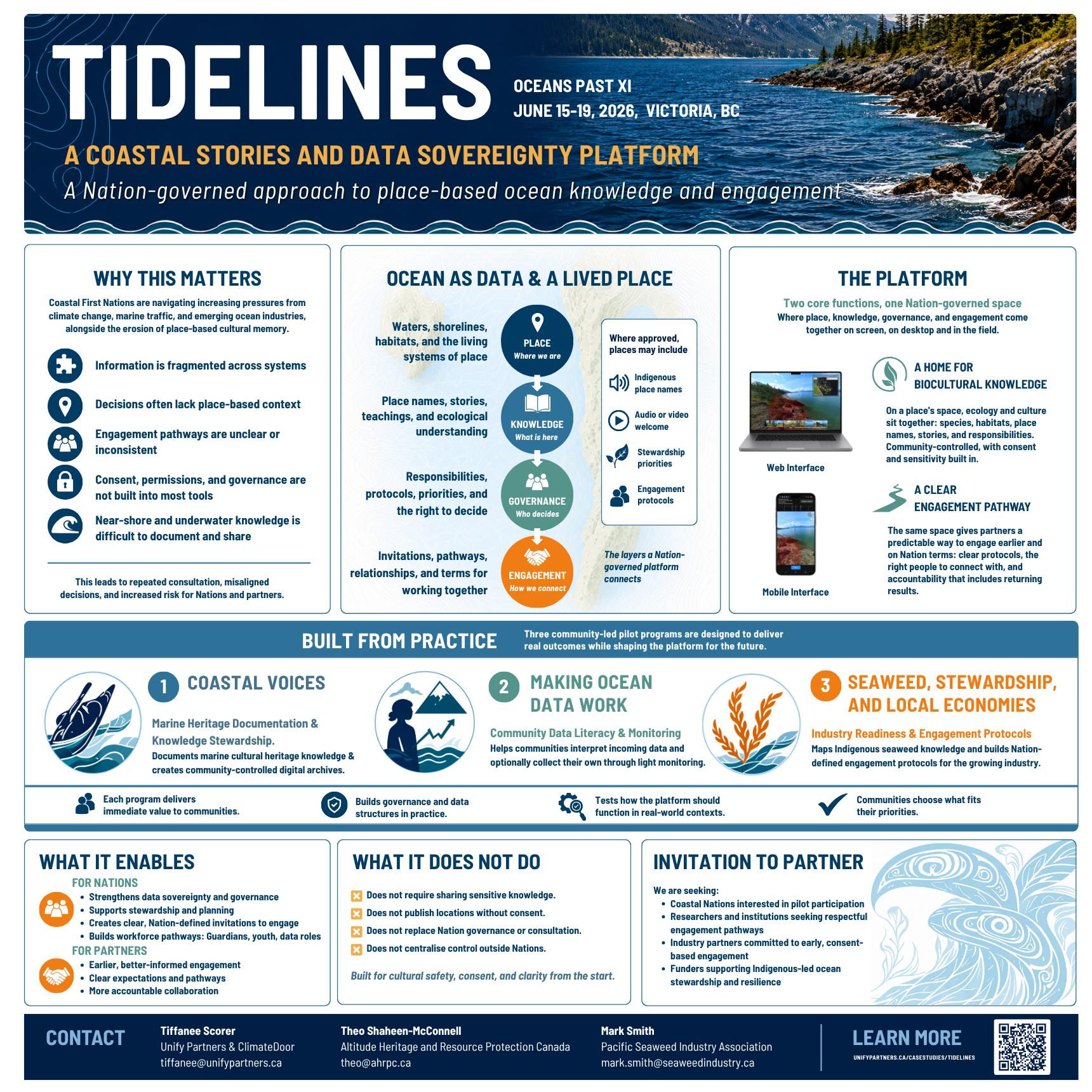
Coastal Indigenous communities face growing pressure from climate change, marine traffic and new ocean industries, alongside the loss of cultural memory tied to place. Decisions are still often made with scattered information, unclear ways to engage and uneven expectations of how partners should approach communities. Tidelines is being built to respond to that gap.
How it will work
Tidelines will bring two things together:
- A home for biocultural knowledge. Ecology and culture sit side by side: species and habitats alongside place names, stories, responsibilities and Indigenous governance protocols.
- A clear engagement pathway. Researchers, governments and industry will get a predictable way to engage earlier, on Indigenous terms, with the right context and a responsibility to return results.
The platform is being designed around consent:
- Participating communities will share only what they choose.
- Consent, permissions and governance will be built in from the start.
- Control will stay with participating communities, not with a central body.
- Everything produced will stay with the community.
A front door to place
Where a community approves it, a place page could open with a spoken place name and a short audio or video welcome. It would then guide visitors to what matters there: community priorities, stewardship work, engagement protocols and the right people to contact.
Tidelines will also bring scattered projects, research and opportunities into one trusted place, so communities can show what is happening and what is needed without repeating themselves. Most ocean data tools are built for scientists and regulators. Tidelines will start from community knowledge and governance and connect outward from there. Guardians and staff will be able to use it in the field, record observations safely and update what they choose to share.
Three pilot programs
Rather than design the platform in the abstract, Tidelines is starting with pilot programs that deliver real outcomes now while showing how the platform should work. Communities choose the programs that fit their priorities and contribute participation, not money. All knowledge, data, equipment, protocols and trained people stay with the community when a program ends. Each program is designed to create paid positions and youth engagement, and to align with existing funding streams.
- Coastal Voices: marine heritage documentation. Elders, youth and Guardians document marine cultural heritage knowledge tied to specific places, creating community-controlled digital archives with clear governance. It adapts to whatever stewardship structure a community already has.
- Making Ocean Data Work: community data literacy and light-touch monitoring. Stewardship offices and Guardian teams receive reports, datasets and monitoring results with no help interpreting them. This program closes that gap and, where communities want it, supports them to start collecting their own data.
- Seaweed, Stewardship and Coastal Economies: knowledge and opportunity mapping. Maps Indigenous seaweed knowledge and builds community-defined engagement protocols for the growing seaweed industry, so communities are prepared, informed and in control as the sector expands into their territories.
Who's involved
Led by Unify Partners
Unify Partners leads Tidelines and brings the collaboration together. Unify is an Indigenous-partnered clean economy organization working with Indigenous communities across Canada, and is the first point of contact for communities, researchers, industry and funders.
Partners
- Altitude Heritage and Resource Protection Canada, which guides the platform software and brings archaeological and heritage expertise
- The Pacific Seaweed Industry Association, which connects the work to responsible seaweed and ocean sector development
- ClimateDoor, which brings technology and industry connections
- Pisces Oceans, the east coast engagement and project design partner
- ClimateDoor Impact, ClimateDoor's Indigenous-led non-profit, which will hold funding for Tidelines and serve as a delivery partner
The work is underway with early funding, in-kind contributions and committed partner time.
Get involved
We are looking for:
- Indigenous communities and Nations interested in taking part in a pilot
- Researchers and institutions looking for respectful ways to engage
- Industry partners committed to consent-based engagement
- Funders supporting Indigenous-led ocean stewardship and resilience
Contact
Tiffanee Scorer, Unify Partners: tiffanee@unifypartners.ca
Theo Shaheen-McConnell, Altitude Heritage and Resource Protection Canada: theo@ahrpc.ca
Mark Smith, Pacific Seaweed Industry Association: mark.smith@seaweedindustry.ca
Pisces Oceans: piscesoceans.ca
Join the Network
Be the first to hear about funding opportunities, new collaborations, and project updates.

Thank you! Your submission has been received!

Quick Links
Contact
© 2026 Unify Partners. All rights reserved.
Unify Partners operates from the unceded traditional territories of the xʷməθkʷəy̓əm (Musqueam), Sḵwx̱wú7mesh (Squamish), and səlilwətaɬ (Tsleil-Waututh) Nations. Our work takes place across many territories and treaty areas throughout Canada and beyond. We are grateful to the Indigenous Nations and communities who care for these lands and waters, and we recognize that the work we do is only possible because of their ongoing stewardship, governance, and generosity.